This essay reflects on childhood, memory, and the landscapes that first taught me what it meant to belong.
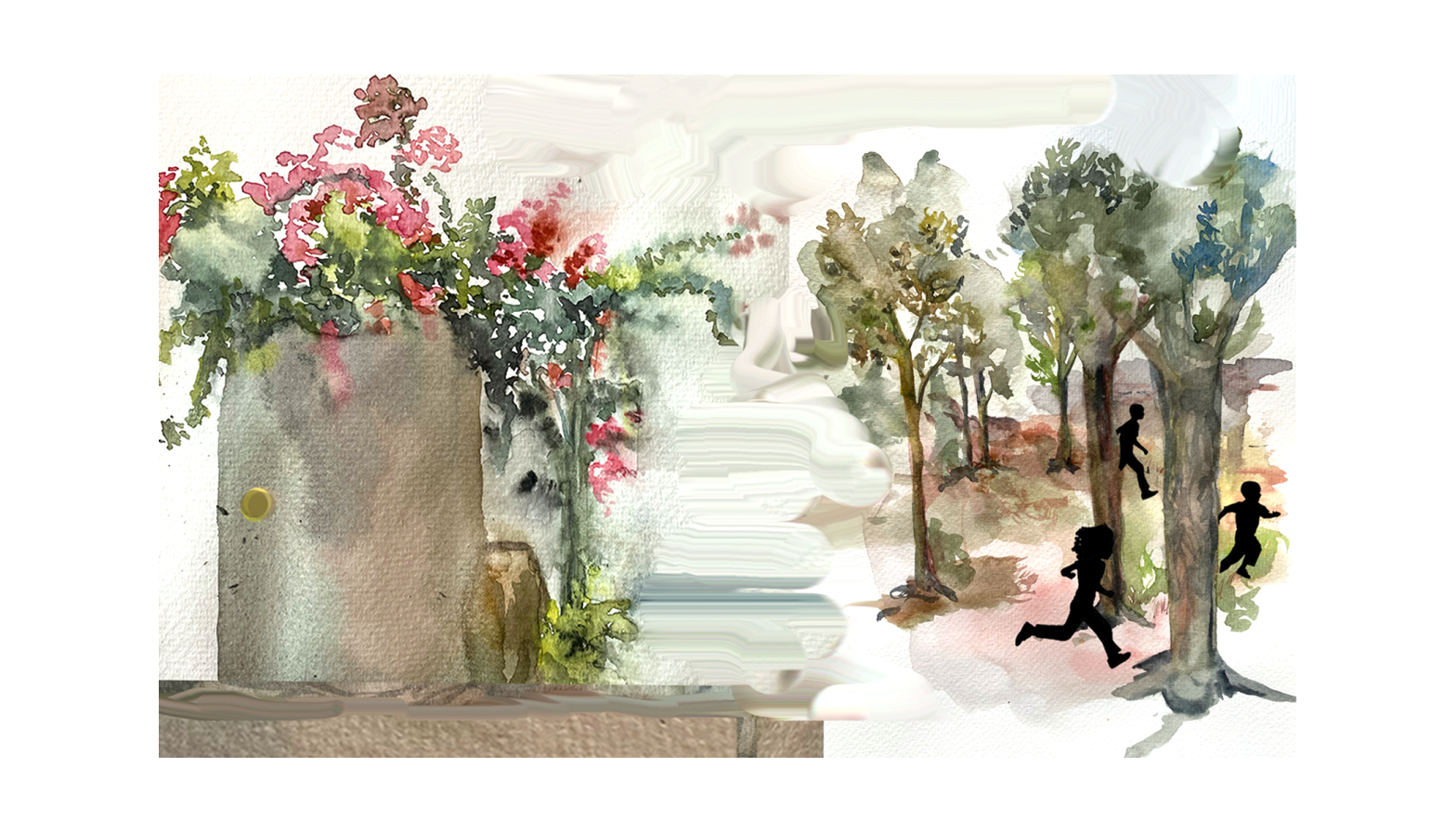
My childhood was spent in the mountains. Under clumps of juniper trees, my siblings and I played with neighborhood children, following invisible pathways between masses of rock where amaryllis burst through in yellow blooms. We inhaled the peppery air, thickened by heat.
A line of juniper trees bordered the half-patched asphalt and rocky driveway that led to a pair of wrought-iron gates: Chant-Ô-Vent. Beyond them, a brick-tiled drive opened into our yard. The house sat at its center, wrapped in my mother’s carefully manicured garden, with the backyard and servants’ quarters tucked beyond. A broad entryway flanked by bougainvillea led into a sprawling house of intricate mosaic tile floors and wide windows. Paintings by renowned Haitian artists adorned the walls, and crystal chandeliers hung from the vaulted ceilings.
Everyone agreed it was one of the most beautiful houses in the Soisson-la-Montagne countryside, nestled in the hills of the Thomassin 25 district in southern Port-au-Prince. It was also one of the few houses surrounded by a sea of scattered one-room wooden huts and rough concrete dwellings where peasant farming families in the region lived.
Our multi-floor house had more rooms than we ever seemed to occupy. Upstairs, my siblings and I each had our own bedrooms and shared a bathroom. My parents’ bedroom was large, with an en-suite that perpetually smelled of my mother’s citrus-lemongrass body powder.
The downstairs living room—also known as the special occasion room—had a curved wall lined with custom-built bookshelves holding old French literature editions my parents had enjoyed in college. Interspersed among the books were framed family photographs: a grainy portrait of my grandfather taken in 1960, a year before he joined the United Nations mission following the Democratic Republic of Congo’s independence from Belgium; a photograph from my parents’ wedding night, my father dashing in his black suit, my mother luminous in white. After dinner, my parents, aunts, uncles, and friends reclined on the long sofa or played pool once Marie had cleared the table.
Swirls of cigarette smoke mixed with the pungent scent of whisky as the men gathered on one side of the room to debate their three favorite subjects—politics, business, soccer—while the women sat opposite, talking about children and the latest gossip. Sometimes I asked my mother if I could sit with them, but she would gently guide me toward the stairwell.
“Go on now,” she’d say. “This is grown-ups’ time. Why don’t you go read one of your books and get ready for bed?”
She would return to the guests, leaving me to wonder why I could never listen in on grown-ups’ conversations with her. At times, I sat at the top of the staircase, peering through the rails, watching them dance and laugh, tilting their heads back and forth until the early hours of morning.
A large sliding door in the living room opened onto a semicircular terrace overlooking the backyard, where avocado and citrus trees grew alongside a small vegetable garden of herbs—mint, tomatoes. In the shadow of a soursop tree stood the servants’ quarters: two modest one-room concrete structures where Marie and Rigaud lived. In the eighteen years I spent in that house, I stepped inside their quarters only a handful of times, out of childish curiosity. They were spare and clean, dimly lit by a single ceiling bulb. Thin mattresses rested on steel bed frames; the walls were bare except for small mirrors meant to lend some fragile sense of dignity.
What I failed to recognize within the gates of Chant-Ô-Vent would not remain hidden from me for long.
It was a very quiet neighborhood. Cars seldom ventured up into the hills to disturb the stillness. Many drivers feared the shrill wail of tires struggling against the halting rocks, scraping the undersides of their cars and threatening unimaginable damage. Exhaust pipes gasped for air as vehicles rocked side to side like jigsaw puzzles. Drivers navigated the narrow roads cautiously, edging along the mountain’s spine where the land fell away into a steep, deadly valley. Only the residents’ four-wheel-drive jeeps and pickup trucks seemed to hum confidently over the rocks, as if guided by long familiarity. And just when the silence grew too heavy, the ringing sound of children’s laughter would fill the air as they chased herded goats down the hill. In wide intervals, you could hear the scrape of cows’ hooves as they labored up the mountain.
Gisandre, Didier, and I scavenged through small streams, bushes, and cornfields of Soisson to reach the neighboring hills of Montagne Noire, where our cousins Sagine, Nadia, and Cedric lived. We spent entire days playing hide-and-seek, soccer, or twirling hula hoops. On other days, we trekked up the rich red mud paths of Thomassin to pick up our cousins Bertrand, Philippe, and Dimitri in Fermathe. Our feet struck the ground in a steady, melodic cadence as we wove up and down the hills—descending into the valley for Sunday church, then climbing again along the paved Route-de-Kenscoff for our favorite stop: the Marché of Fermathe.
Marked by the towering bells of the Église Saint-Jacques, the church presided over a buzzing, disheveled marketplace that spilled informally down the narrow stairwell streets leading past its entrance. Street vendors crowded both sides of the road, squatting on the ground beside baskets of fresh produce, secondhand clothes, and shoes, preparing for long days of negotiation with passersby.
At the bottom of the stairwell sat an animated, rainbow-colored Tap Tap station filled with travelers in transit. Brightly painted buses and pickup trucks served as shared taxis, Greyhound-style coaches, cargo haulers, and all-purpose vehicles that carried anyone—and anything—from Point A to Point B in Haiti. I remember watching the long-distance buses being packed to the brim with people and merchandise. When there was no room left inside, goats and chickens were tied to the roof rails, dangling along the sides, while a few daring souls climbed atop the vehicle, whispered prayers, and held on as the bus pulled away.
With no public transportation provided by the government, Tap Taps—also known as camionnettes—were privately owned and ornately decorated vehicles for hire, following informal yet fixed routes where passengers could disembark at any point along the journey. Often dismissed as “poor man’s transport,” they were controlled by private associations that filled the void left by government neglect. To me, they were floating works of art, each one telling a piece of the Haitian story.
The hum of honking cars and camionnettes forcing their way up the road mixed with shouted negotiations in the marketplace, hanging in the air like a working engine. Crowded, makeshift food stalls near the Tap Tap station were piled high with greasy, deep-fried pork known as griot and expertly pressed banan peze. The scent of animal fat—fried and re-fried over propane flames and under the sun—filled the air. Vendors and customers shouted back and forth like buzzing bees, negotiating prices, placing orders, deciding who had arrived first.
Our short, stumpy feet approached the cook as she sweetly asked, “Sa’w vle, cheri?” We bought grease-soaked paper plates of griot and banan peze, topped with generous spoonfuls of sun-warmed pikliz—a spicy pickled mix of cabbage, carrots, and hot peppers capable of setting any bull’s heart ablaze. If one of us felt especially brave, we ordered the Bib—or Bible—the mother of all sandwiches. Stuffed with freshly baked pen rale bread, griot, fried green plantains, pikliz, and thick slices of avocado, it barely fit between two hands.
Portions in Haiti are always generous. Nurturing Haitian women believed everyone was twò mèg—too thin—and needed to be fed to sleep, or fed enough to last days, if necessary, until the next meal could be found. With each bite, a burst of savory oil shot across the roof of my mouth, followed by the warm, prickling heat of peppers tingling my tongue. The soft, cushiony bread gathered the carnival of flavors as it traveled down my throat. As if that weren’t enough, we washed it all down with large gulps of ice-cold Cola Couronne, letting the bubbles fizz in our mouths and reawaken every lingering taste. I savored every glistening, greasy morsel.
Those moments were golden.
We were well known in the neighborhood for the ease with which we moved among other children, whether it was Ti Luc Dieudonné, the cowherd’s son from Duvette, or Eric Dufort, the senator’s son from the valley below. We played with everyone.
Until the day I knew I was other.
On one of our daily walks through the neighborhood, we came upon a group of children playing inside an abandoned, unfinished house. We wanted to join them, but as we approached, they began speaking to us in a strangely accented dialect. Didier and Gisandre frowned immediately, while I struggled to understand what they were saying.
“Zou spik zanglish?” one of the boys shouted.
Seeing our confusion, another chimed in, “Yo blan, nou pa konpran’n?” The words hung heavily in the air. When the boy called us whitey, my blood ran cold. I felt cast out, suddenly aware that I was standing in territory where I did not belong.
“Sa’w di la?!” my brother shouted, demanding they repeat what they had said.
Their eyes widened in shock at the sound of Creole spilling from his mouth.
“Why are they looking at us like that?” I asked nervously, searching my siblings’ faces for guidance.
“They’re pretending they don’t understand us,” my brother muttered angrily. “They know exactly who we are.”
“Pay them no mind,” my sister said calmly. “Keep your cool.”
My gaze darted between my siblings and the boys as the standoff stretched on. I searched their faces for some signal of release, some sign that the tension might dissolve and allow me to breathe again. A few of the boys seemed to soften, smiling tentatively as if ready to extend a hand in friendship.
But the eldest among them—nearly a teenager, like Gisandre—was determined to remind us that we did not belong. His brow knotted into a deep frown, his eyes rimmed red with envy. A crooked smile curled at the edge of his mouth, revealing a glimpse of mocking teeth, eager and sharp. I had seen that look before. It was the early imprint of a hatred that often hardens adult faces.
To break the silence, he let out a high-pitched “hee-hee-hee,” encouraging the others to swarm around us. They crossed their eyes, pinched their nostrils, puckered their lips, mimicking what they imagined blans to be. There was nothing pointy about our broad noses or perky about our full lips, but it did not matter. The message was unmistakable.
Gisandre stood frozen, save for the rise and fall of her breathing. She was always the unflinching protector. Didier, meanwhile, flushed with fury. Unable to bear the ridicule, he leaned forward, ready to lunge, when Gisandre quickly thrust her arm out to stop him.
Some of the smaller boys found other ways to provoke us. They dropped to the ground, planted their hands, and hoisted themselves into handstands so their naked, wiggling bodies shook in our faces.
I began to cry and scream, “I want to go home! These boys don’t want to play with us. They’re just being mean, and we didn’t do anything wrong!”
I had had enough. I could no longer endure the humiliation. Delighted by my tears, the boys ran toward us, reaching out to touch us, to test whether we were real—whether we felt different to the touch. Gisandre and Didier swatted their hands away as I screamed louder, overwhelmed, as if being stung by a swarm of mosquitoes.
Furious and outnumbered, my siblings each grabbed one of my arms and lifted me off the ground. We fled, their feet pounding against the earth as we raced home. I did not touch the ground again until we reached the front gate.
“We made it home. You can stop crying now,” they said sharply. “Wipe your face so Mom doesn’t ask too many questions.”
What? You want me to lie to Mom? I thought. All I wanted was to tell her what had happened so she could make it better. But Gisandre and Didier urged me to calm down, to breathe deeply, to quiet my sobs. Though uneasy with the idea of lying, I nodded and followed their lead, my swollen face betraying everything.
As we entered through the kitchen, they peered through the window to see whether my mother was nearby. She moved between the kitchen and dining room, preparing the evening meal. Fearing her questions—why we were home so early, why I had been crying—they wiped the last of my tears away.
“Hi, Mom!” they shouted as we bolted up the stairs.
“Oh! Hi!” she called back. “What are you doing home so early?”
“It’s too hot outside,” we answered in unison. “We decided to play inside instead.”
“Alright. Don’t make a mess up there—Rigaud just cleaned your rooms,” she replied.
We spent the rest of the afternoon alone, each of us retreating into our own quiet corners. I never asked my brother or sister how the encounter had affected them; their expressions said enough. We never told our parents what had happened. It became a shared silence, something we carried quietly, each of us left to unravel its meaning on our own.
 In Written Word